About me
I'm Matias Brandt Møller, an engineer working across spatial computing, 3D, and AI, based in Denmark.
I've always built things. That instinct moved through electronics and film into 3D, and eventually towards a broader question: how can computers understand, represent, and interact with the physical world?
At university I was researching how people navigate and experience immersive environments — working with VR just as the Oculus Rift was bringing the medium back into relevance. My master's thesis was on making fluid simulations feel real — bridging the gap between computational fluid dynamics and visual plausibility. My degree in Medialogy also gave me an early grounding in machine learning — pattern recognition and multivariate statistics, implemented in MATLAB, back when that was the lingua franca of numerical computing. The questions that work raised — about translating between physical systems, computation, and human perception — have shaped everything since.
In visual effects, those questions played out at scale. Over a decade as an FX Artist and Supervisor on film and television, I built large-scale physics simulations in Houdini, developed complex pipelines, and created tools used across multiple productions. The work was as much engineering as craft — writing the code that made the art possible.
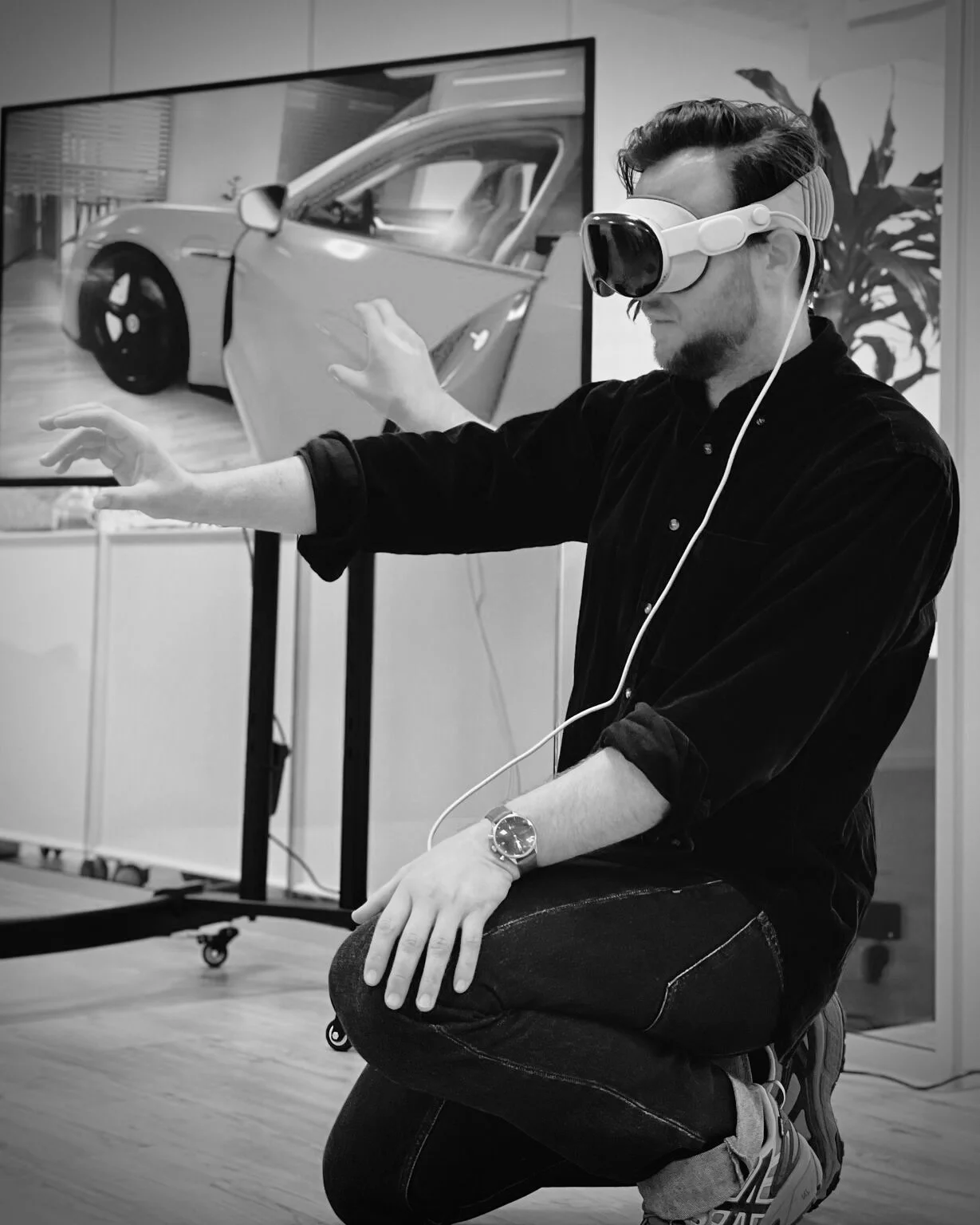
Today, I apply that experience to spatial computing — building applications, 3D tools and pipelines that connect digital systems with the physical world, from procedural systems and digital twins to real-time experiences in visionOS, applied machine learning, and AI-powered spatial interfaces. Along the way, I've reconnected those early machine learning foundations with modern methods — building synthetic data pipelines in Houdini, training classifiers that understand spatial input, and deploying models into real-time environments. Theory tested in production.